A collaboration to make Mumbai green this Independence Day
The Hindu
The Bombay Canteen, as part of its annual Independence Day Daawat, has collaborated with Nature:re, an RPG Foundation initiative to transform Mahalaxmi’s Captain Namdev Lotankar Park into an ecologically-driven urban oasis
This Independence Day, the worlds of food and Nature will collaborate to bring down Mumbai’s increasingly warm temperatures in a bid to invite more butterflies and birds to Mahalaxmi that lies at the heart of the city. To make this happen, The Bombay Canteen as part of its 10th annual Independence Day Daawat has collaborated with Nature:re (Nature Rebalance), an RPG Foundation initiative that is dedicated to making Mumbai green. The initiative aims to rebalance the environment by planting native trees and transform Mahalaxmi’s Captain Namdev Lotankar Park into an ecologically-driven urban oasis. This effort aims to restore the city’s biodiversity.
By 2030, 60% of the world’s population will live in cities, putting immense pressure on urban green spaces that are rapidly disappearing. In 2024, India recorded its highest-ever temperature of 52.3° Celsius, highlighting the urgent need for more green spaces. Radha Goenka, director, RPG Foundation says, “Redesigning parks with native plants will help absorb carbon dioxide and naturally cool the city.”
At least 194-odd native species have been sourced from nurseries in Pune and Nashik, with manure and soil. These include flowering plants: Blascoi elaeocarpus, Red Sandalwood, Assam Catkin Yew, Diospyros ebenum (Temburini tree), Krishna fig, and Ashwagandha. These plants are said to attract butterflies (common Mormon, crimson rose, common emigrant, blue Mormon and more); bees (solitary bees, carpenter bees, leafcutter to name a few); birds including paradise flycatcher, hornbills, whistling thrushes, kingfishers and parakeets, frogs, geckos, and insects such as dragonflies and damsel flies.
A team of eight ecological landscape architects and biodiversity experts (botanists/zoologists) are part of this project. A baseline study was conducted to map the existing species of flora and fauna. These species are native to the region and ensure ecological balance, a team member at the park explains. They are non-threatening to local flora and fauna, aid in soil conservation, promote local biodiversity and contribute to restoring the water table.
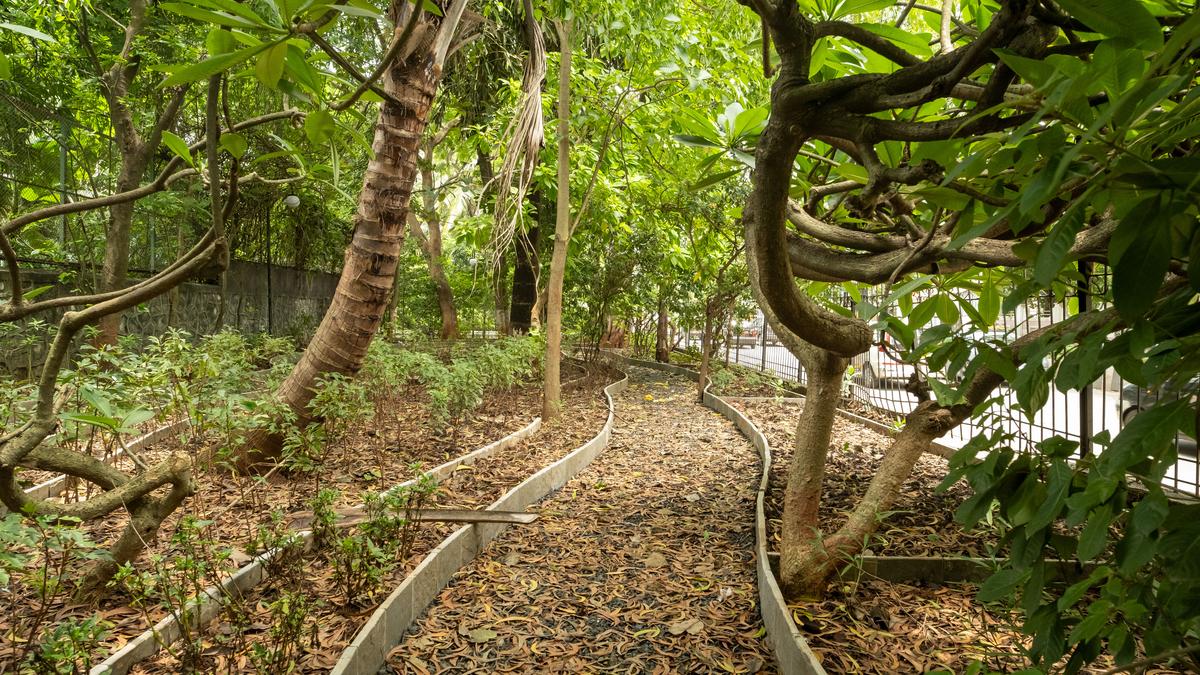
The project that began in April, aims to see its completion by the end of August. Radha says, “The 375 metre long and eight-metre wide Captain Namdev Lotankar Park that adjoins the historic Willingdon Sports Club, has always been a Brihanmumbai Municipal Corporation (BMC) park with a walking pathway and gymnasium equipment. We recorded 90-odd species of trees and plants there that include 11 rain trees. We are creating drainage, irrigation, planters and binding large rain trees with basalt stones to create a seating space. In terms of design, we have nine different zones connected to each other with the help of a mud pathway created using khadi stones (gravel) and after the rains stop, this will be layered with murum soil. Using locally sourced Kota stones, we have partitioned the walking path with the plants.”
Entering this small park one already feels a little cooler. “In the Butterfly Zone, we have planted flowering plants which allows butterflies to lay eggs and feed on the nectar. Considering the lifecycle of some butterflies, bees, birds and insects, we have maintained a ratio of 70% native and 30% exotic,” Radha explains. The team at the park is also placing signages with a quick-response code and details of the species, to educate visitors.
By partnering with Nature:re, Sameer Seth, founder-CEO, The Bombay Canteen (Hunger Inc. Hospitality) says, “We aim to make our city a better place to live. To kickstart this initiative, we are using proceeds from the Independence Day Daawat. Educational trails, informative signage, and designated seating areas will allow visitors to connect with Nature in a meaningful way.”


Parliament Budget Session LIVE: Follow The Hindu's latest updates on the Parliament Budget Session on March 23, 2026.

T. Nagar faces severe infrastructure challenges amid commercial growth, impacting emergency services and resident quality of life.

Five individuals detained after a man's death due to a lift malfunction at R.G. Kar Hospital in Kolkata.

In 2014, Amazon introduced its first smartphone, hoping to take on Apple and Samsung. Instead, the Fire Phone, overseen directly by founder Jeff Bezos, was scrapped in barely over a year, one of Amazon’s highest-profile flops.

A data jam on March 28 by OpenCity will have participants studying how the Assembly constituencies in and around Chennai are faring on a set of parameters

IUML files police complaint over a fake Facebook post targeting its leader, warning against misinformation and potential legal action.

Experience global flavors at Vizag's 'World Flavours' food festival, celebrating cultural unity through authentic international cuisines.

Three men were killed in a road mishap after their mini truck crashed into a stationary truck near Medahalli in east Bengaluru on Saturday night, police said.

Kerala's critical sectors face LPG shortages despite a 20% relief allocation, impacting restaurants and hotels significantly.

Explore the Sattankulam custodial torture deaths of P. Jayaraj and his son J. Benicks, revealing a shocking tale of police brutality.

Explore the Sattankulam custodial torture deaths of P. Jayaraj and his son J. Benicks, revealing a shocking tale of police brutality.

The 2026 Assembly elections in India will involve Assam, West Bengal, Kerala, Tamil Nadu, and Puducherry across 824 constituencies.

Ernakulam initiates a drive to recycle old clothes into eco-friendly mobile holders for polling stations, promoting sustainability.