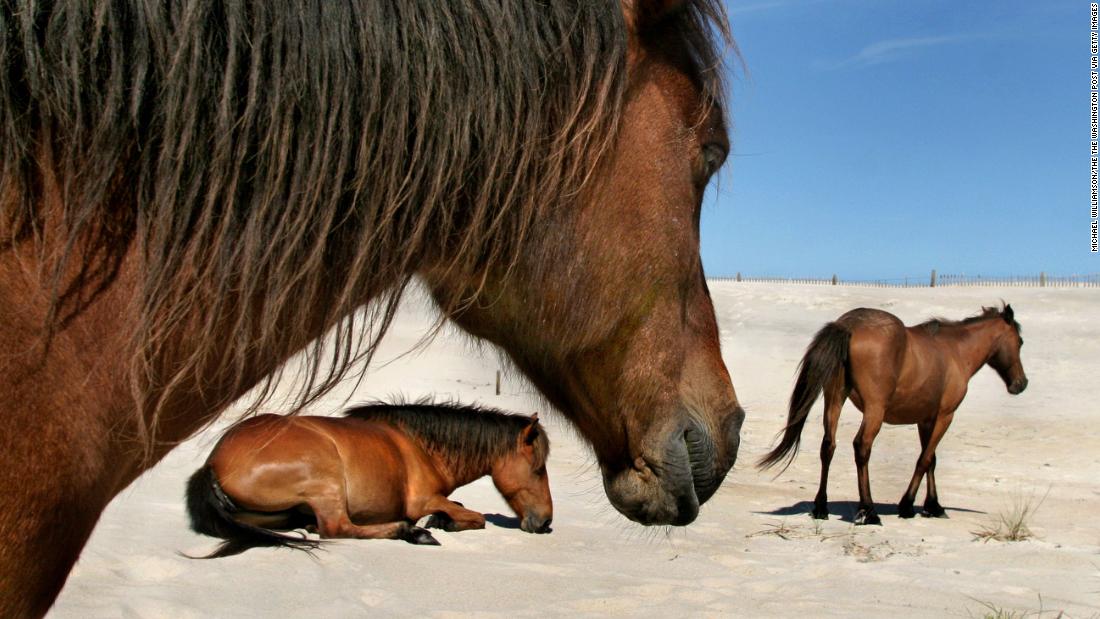
A centuries-old horse tooth might be the last piece in the genetic puzzle of Assateague's horses
CNN
The unexpected discovery of a 16th-century horse tooth in modern-day Haiti has provided credence for an age-old folk story about the origin of feral horses on an island off Maryland and Virginia.
The famous wild Chincoteague ponies have lived for centuries on Assateague Island, a barrier island on the Atlantic coast. But no one is quite sure how they got there. A 1947 children's book inspired by local legend, "Misty of Chincoteague," suggests that the ponies are the descendants of Spanish horses who swam to the island after a Spanish ship wrecked off the coast of Virginia, reverting to a feral state over the years.
But research published in PLoS ONE by scientists from the Florida Museum of Natural History on July 22 provides new scientific support for the theory based on the discovery of the oldest known DNA from a domesticated horse in the Americas.


Public opinion on nearly every aspect of President Donald Trump’s first year back in the White House is negative, a new CNN poll conducted by SSRS finds, with a majority of Americans saying Trump is focused on the wrong priorities and doing too little to address cost of living.

Jacob Frey delivered a stern message one week ago to federal agents following the deadly shooting of a Minnesota woman who was protesting their efforts to round up immigrants in the state. “Get the f**k out of Minneapolis,” Frey said.

Tensions flared in Minneapolis again Thursday in the wake of a second shooting by a federal immigration officer in just one week, as President Donald Trump threatened to invoke a centuries-old law that would allow the deployment of US troops to Minnesota.

When Venezuela’s opposition leader María Corina Machado walked into the White House on Thursday, she came bearing the gift US President Donald Trump has long coveted: a Nobel Peace Prize.

Dolls, pencils, backyard chickens and ‘a piece of broccoli’: The Trump team’s awkward austerity talk
Amid the European debt crisis in the early 2010s, a Fox News pundit named Donald Trump warned about a backlash against leaders asking people to tighten their belts.

The longtime government contractor whose activity prompted the controversial search of a Washington Post reporter’s home acknowledged he mishandled classified information, prosecutors said, according to a court hearing transcript obtained by CNN.

President Donald Trump has been threatening to invoke the Insurrection Act for a very long time. Dating back to his first term, he has repeatedly floated the rarely invoked law, which gives a president extraordinary powers to dispatch the military to put down domestic unrest.

Haitian security forces on Wednesday bombed three houses belonging to top gang leader Jimmy “Barbecue” Cherizier, local outlet Gazette Haiti reported on Wednesday, after unverified footage showed a large explosion in the capital Port-au-Prince.

Depending on how the department chooses to implement the change, costs could range from $10 million to $125 million, the CBO said in a letter to two Democratic senators.

Tensions flare in Minneapolis after federal agent shoots and injures man who allegedly assaulted him
Law enforcement and demonstrators clashed last night near where a federal agent shot and injured a man after he allegedly assaulted the agent. The city is reeling over last week’s fatal shooting by an ICE agent of Renee Good sparked nationwide protests. Follow for live news updates.

President Donald Trump seems to be running out of ways to assure everyone that he’s dead-serious about taking over Greenland.

Three-quarters of Americans say they oppose the US attempting to take control of Greenland, according to a new CNN poll conducted by SSRS, indicating that President Donald Trump’s push to expand America’s territory faces stiff headwinds with the public.

As millions of Venezuelans wait to see what will become of their economically and politically ravaged country, a battle has emerged between two female leaders for control over the nation’s future – and for the American president’s favor.