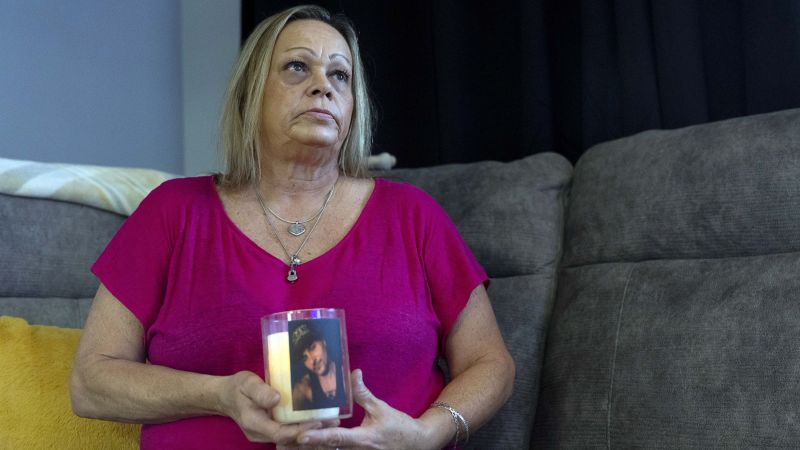
A Baltimore man died after being sedated and restrained by medics. His mom wants answers
CNN
When Trea Ellinger left a Baltimore drug rehab facility last summer, he assured his anxious mother that everything was fine. He had his medications and was planning to meet up with his girlfriend.
When Trea Ellinger left a Baltimore drug rehab facility last summer, he assured his anxious mother that everything was fine. He had his medications and was planning to meet up with his girlfriend. By the following afternoon, he was dead — not from the violence his mom feared he might face, but because he didn’t survive an encounter with first responders in downtown Baltimore. Ellinger, 29, died after being sedated and restrained. Despite repeated comments from police and medics at the scene acknowledging the dangers of lying face down in the prone position, responders failed to act urgently when the handcuffed Ellinger turned onto his stomach and remained that way for several minutes, according to investigators and experts. His death adds to a list of similar cases. A recent investigation led by The Associated Press found that the practice of giving sedatives to people detained by police has spread quietly across the nation over the last 15 years. The strategy, which was intended to reduce violence and save lives, has resulted in some avoidable deaths. In Ellinger’s case, the autopsy determined that he died from overdosing on an antidepressant and methadone, which is commonly prescribed to curb opioid cravings. The findings didn’t say if other factors might have contributed to his death. His mother, Lori Ellinger, questions the autopsy’s findings and wants to know why paramedics decided to use an injectable sedative.


Cuba is working to restore the electricity supply after another island-wide blackout left more than 10 million people without power.

President Donald Trump said Sunday border czar Tom Homan will be in charge of deploying Immigration and Customs Enforcement agents to airports on Monday, with Homan telling CNN the agents will help with security at entrances and exits to ease the Transportation Security Administration’s workload.

Donald Trump wants us to believe that a deal with Cuba is close at hand. After this past week, I am not so sure.

President Donald Trump has said ICE agents will head to US airports tomorrow amid a partial government shutdown. Follow for live updates

President Donald Trump said Sunday border czar Tom Homan will be in charge of deploying Immigration and Customs Enforcement agents to airports on Monday, with Homan telling CNN the agents will assist with security at entrances and exits to ease TSA workload amid a partial government shutdown.

Janet Mills and her allies are counting on a gender gap to narrow Platner’s wide lead ahead of the June 9 primary to decide who will face incumbent Republican Sen. Susan Collins. They are betting that the unfiltered style that has brought Platner widespread attention as someone who could help Democrats reach young men will backfire with women.

Why do people “pledge allegiance” to a “state” that is no longer a state? And what spurs someone to not just attack innocent people, but to then make a statement of loyalty while doing so?

A Supreme Court case examining state deadlines for election ballots sent in the mail is just the tip of the spear in President Donald Trump’s war on mail-in voting.

As a shrinking number of Transportation Security Administration agents work to keep hourslong security lines moving despite not being paid, President Donald Trump stepped into the fray Saturday, announcing he will send Immigration and Customs Enforcement officers to airports by Monday if Congress doesn’t agree to a plan to end the partial government shutdown.

Donald Trump wants us to believe that a deal with Cuba is close at hand. After this past week, I am not so sure.

The search for missing 84-year-old Nancy Guthrie, mother of “Today” show host Savannah Guthrie, has stretched into another anguished week, with mounting pressure on investigators and a family grappling with uncertainty.

Cuba’s Ministry of Energy announced Saturday evening that entire island has suffered another electrical blackout, leaving more than 10 million people without power.

Iran’s attempt to strike a US-UK base over 2,000 miles (over 3,000 kilometers) off its coast has renewed questions about Tehran’s military capabilities and how far its missiles can reach.