800-year-old Shiva temple of later Pandya period unearthed near Melur
The Hindu
800-year-old Shiva temple unearthed in Udampatti reveals ancient inscriptions detailing temple's financial independence and historical significance.
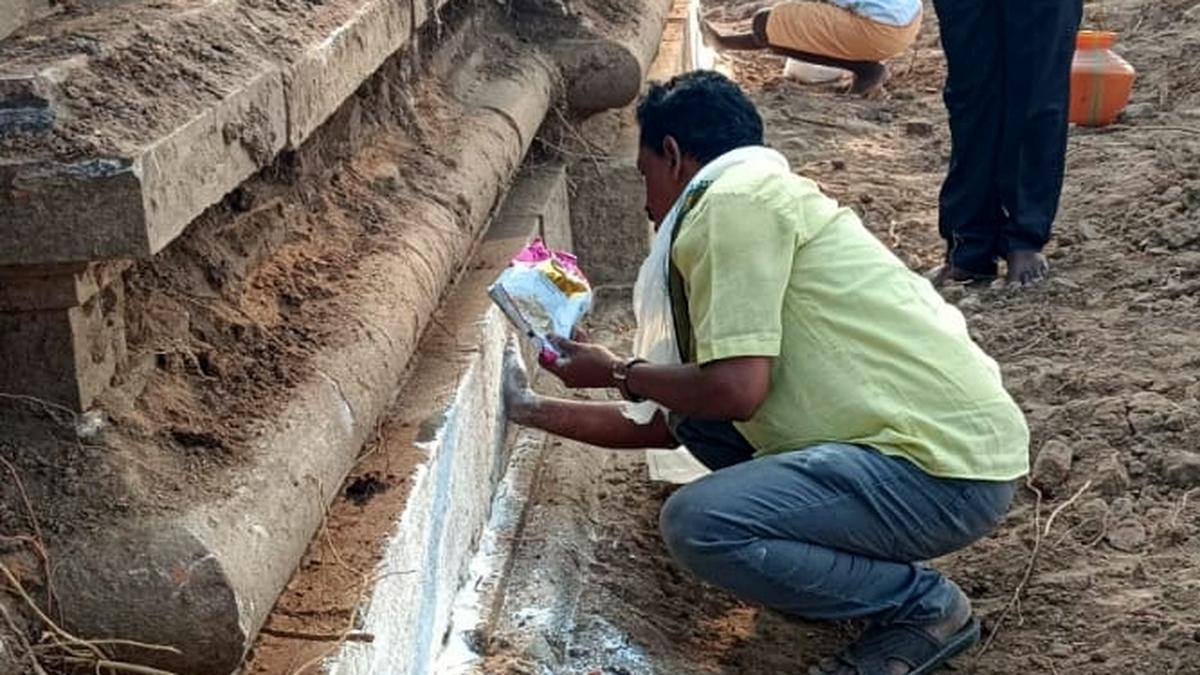
An 800-year-old Shiva temple of the later Pandya period has been unearthed at Udampatti, a village in Melur taluk.
Professor P. Devi Arivu Selvam, temple architect and sculpture researcher, says that though only the foundation of the temple remains, the inscriptions on the culvert are significant as they reveal how the temple had been financially independent.
While documents published by the Tamil Nadu State Department of Archaeology in 1974-75 had described the existence of ancient temples in this belt, most of them are in ruins and some have almost disappeared. So, it came as a surprise to historians when recently boys playing in an open ground at Udampatti in the Malampatti panchayat stumbled upon a broken stone structure covered in mud.
The villagers alerted the Village Adminsitrative Officer (VAO) and Ms. Devi. With the VAO’s permission, the area was cleared. What emerged was the foundation of a temple with the stone base on the northern and southern sides intact.
With the help of the engravings on the foundation stone and Silpa Sastram as reference, the temple was found to have been dedicated to Lord Shiva.
C. Santhalingam, archaeologist and secretary of the Pandya Nadu Centre for Historical Research, who deciphered the two Tamil inscriptions found on the stone base, says they can be dated to 1217-1218 CE, during the reign of Maravarman Sundara Pandya.
The inscriptions say the name of the village was Attur and the temple was called Thennavanisvaram. “It is pertinent to note that Thennavan is actually a title used by the Pandyas,” says Ms. Devi.


S. Madhivanan assumed office as Deputy Commissioner of Police, Madurai North, on Thursday. A 2022-batch IPS officer, Mr. Mathivanan was hitherto Assistant Superintendent of Police, Aruppukottai. He succeeds G.S. Anitha, who has been transferred as Superintendent of Police, Perambalur district.

Telangana Assembly sessions resume today, focusing on intense debates over water politics and irrigation project mismanagement.

Tamil Nadu government school teachers protest for equal pay, highlighting significant pay disparities and demanding resolution from the state government.

Sheetal and Jithin celebrate a unique wedding, exchanging copies of the Constitution to embody constitutional values and simplicity.

Kogilu demolition: Alternative housing distribution for eligible families begins January 2 amid protests over unclear eligibility criteria.

Kashmir's golden triangle sees record hotel occupancy on New Year's Eve, marking a positive turn for tourism after recent challenges.

Maradu chairperson prioritizes waste management solutions and improving sanitation facilities amid growing challenges in the municipality.

Fifty-two persons, including 23 students, tested positive for narcotic drug consumption, following 1,000 screening tests conducted across hostels, Paying Guest (PG) accommodation and other places in Mangaluru on Tuesday and Wednesday, according to city police.

Karnataka's liquor sales surged to ₹1,669 crore in December, boosting excise revenue despite overall declines in IML and beer sales.

On New Year’s day, the Health department kicked off a major campaign aimed at encouraging people to embrace the wellness journey by pledging to adopt good dietary habits, sleep adequately, exercise moderately and take self care seriously.

Air Marshal Seethepalli Shrinivas takes charge as AOC-in-C of IAF Training Command, bringing extensive experience and accolades.

Yemen's STC allows Saudi-backed forces into seized territories, raising tensions between UAE and Saudi Arabia amid ongoing conflict.

Temples and churches in Tiruchi attracted thousands on New Year's Day, celebrating with prayers and festivities.