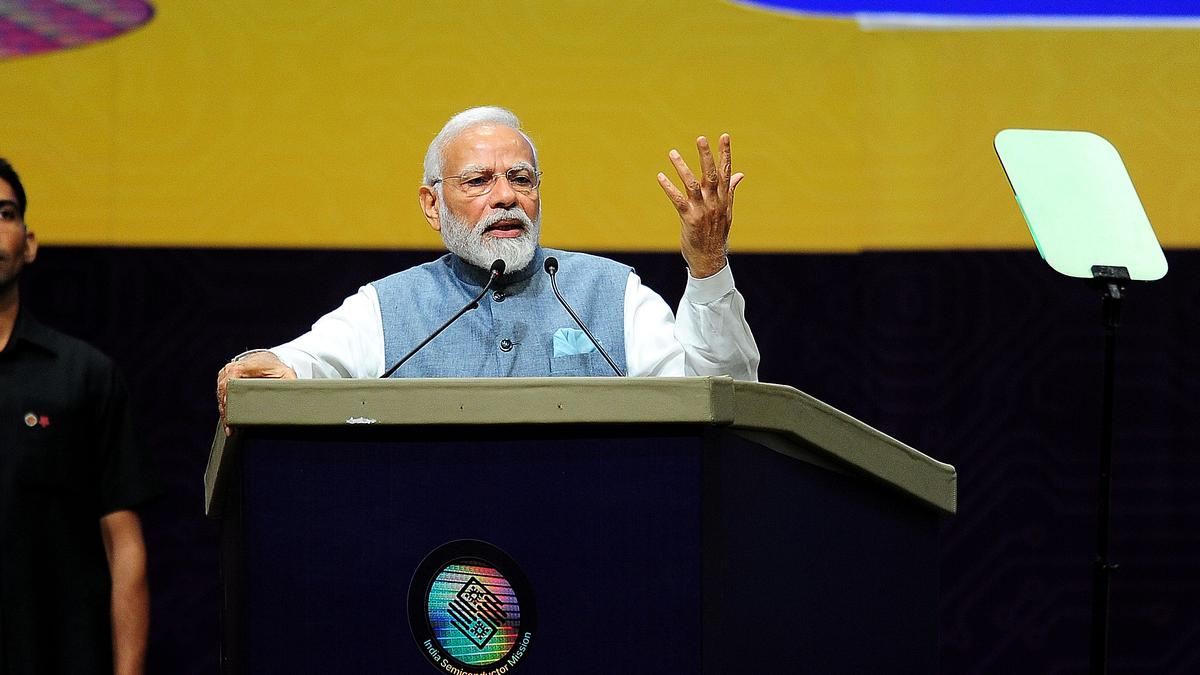
50% financial assistance to firms setting up semiconductor-manufacturing unit in India: Prime Minister Modi
The Hindu
Technology firms will be given 50% financial assistance for setting up semiconductor-manufacturing facilities in the country, Prime Minister Narendra Modi said on Friday, July 28, 2023. Speaking after inaugurating Semicon India 2023 conference, Mr. Modi announced that his government had rolled out the red carpet for semiconductor industries.
Technology firms will be given 50% financial assistance for setting up semiconductor-manufacturing facilities in the country, Prime Minister Narendra Modi said on Friday, July 28, 2023, as he announced that his government had rolled out the red carpet for semiconductor industries.
Speaking after having inaugurated the Semicon India 2023 conference in Gandhinagar, Mr. Modi said India was establishing an entire ecosystem for the semiconductor industry to grow in the country.
“We were offering incentives as part of the Semicon India programme. It has been increased, and now technology firms will get 50% financial assistance to set up semiconductor-manufacturing facilities in India,” Mr. Modi said, adding that the semiconductor industry would witness exponential growth in India.
“A year ago, people used to ask why they should invest in the Indian semiconductor sector. Now, they ask why not invest in India?” he said, adding that the country was becoming a grand conductor for investments in the semiconductor sector.
The world needs a trusted and reliable chip-supply chain, he said.
Mr. Modi said 300 colleges in India had been identified for offering courses on semiconductor design.
Every industrial revolution that the world has witnessed was driven by people’s aspirations, Mr. Modi said, adding that he believed the fourth industrial revolution currently under way was being driven by India’s aspirations.


Oil companies reassure the public of no fuel shortage, urging against panic buying and reliance on verified information.

GameStop reported a 14% drop in fourth-quarter revenue on Tuesday, a sign that its struggling brick-and-mortar business continues to face immense pressure

Epic Games said Tuesday it is laying off 1,000 employees to save money as it grapples with industry-wide and company-specific challenges.

Indian stock markets rise 2% as investor optimism returns amid easing crude prices and improved geopolitical clarity.

Gold and silver prices rebounded on March 25, but remain under pressure amid high volatility and global uncertainties.

Gaining the approval of local communities has become paramount to building data centres in the U.S., Microsoft President Brad Smith said

OpenAI on Tuesday announced key leadership appointments for its nonprofit arm and committed to investing at least $1 billion through the division

EU antitrust chief Teresa Ribera, who has voiced concerns about Big Tech extending its dominance into artificial intelligence, will meet the CEOs of Alphabet, Meta Platforms and OpenAI

OpenAI is close to securing about $10 billion in fresh funding from investors, boosting its valuation to $850 billion, including the money raised, a person familiar with the matter said, confirming an earlier report in Bloomberg News

Discover the key changes in the New Income Tax Rules 2026, simplifying compliance and enhancing deductions for taxpayers.

Palantir, which won a contract to supply AI systems to Britain’s Financial Conduct Authority, will not have access to regulatory intelligence, an FCA official said

Arm Holdings announced a new artificial intelligence data centre chip on Tuesday which it said will add billions of dollars of revenue

Amazon said on Monday its Amazon Web Services region in Bahrain has been “disrupted” amid the current conflict in the Middle East