5 things to know for May 2: May Day protests, PBS-NPR funding, Alien Enemies Act, Mike Waltz, Gaza
CNN
CNN’s 5 Things AM brings you the news you need to know every morning.
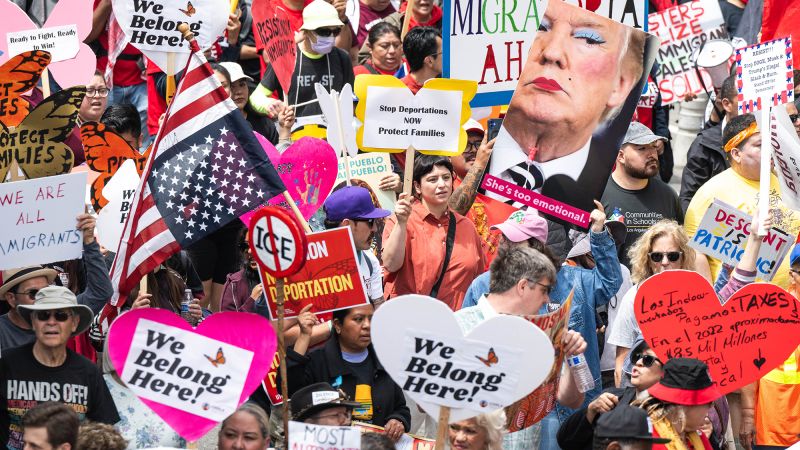
Ever heard of the de minimis exception? It’s about to make President Donald Trump’s trade war with China hit much closer to home. The exception is a major shipping loophole that allowed the importing of goods worth less than $800 to come into the US duty-free and often without time-consuming inspections and paperwork. However, the exception expired at one minute past midnight, which means nearly 4 million duty-free shipments a day will now be subject to a tariff. Since many of those items are sold through ultra-low-cost Chinese e-commerce sites like Shein, Temu and AliExpress, the tariff could be as high as 145%. Here’s what else you need to know to Get Up to Speed and On with Your Day. Thousands of protesters rallied across the US on Thursday in response to the Trump administration’s actions on immigration, the war in Gaza, federal workers and unions. The demonstrators, who were organized under the banner of the grassroots “50501” movement, filled the streets of major cities and small towns holding signs and calling for change. “Trump has poor and working-class people forgetting who our enemies are. Our enemies are not international students that organize on their campus. Our enemies are not undocumented workers that contribute to their communities, that pay taxes and can’t get services. Our enemies are not workers that work for corporations,” an organizer said to a large crowd gathered in New York City’s Union Square. “No — this racist, sexist, anti-worker, homophobic, xenophobic, transphobic system is our enemy.” More demonstrations are scheduled to take place on Saturday. President Trump signed an executive order Thursday directing the Corporation for Public Broadcasting to end federal funding for NPR and PBS, which provide free and universal access to educational shows, emergency alerts and a wide array of news and cultural content. Trump’s order also instructed the CPB’s board to take steps to “minimize or eliminate” indirect funding to the country’s two biggest public broadcasters. In addition, Health and Human Services Secretary Robert F. Kennedy Jr. was ordered to investigate NPR and PBS for possible employment discrimination. Each year, the CPB disperses $535 million in taxpayer funds to public radio and TV stations, an effort that Congress has reauthorized for decades. The CPB filed a lawsuit against the administration this week after Trump fired three board members by email, arguing that under the law, he didn’t have the authority to terminate them. A federal judge in Texas ruled Thursday that President Trump had unlawfully invoked the Alien Enemies Act to speed up deportations. It was the first time a judge has concluded that the president exceeded his authority by relying on a law that was intended to be used during times when the US was at war. US District Judge Fernando Rodriguez, who was appointed by Trump, also blocked the administration from using the law to quickly deport any alleged members of the Venezuelan gang Tren de Aragua within his district. “The President cannot summarily declare that a foreign nation or government has threatened or perpetrated an invasion or predatory incursion of the United States, followed by the identification of the alien enemies subject to detention or removal,” Rodriguez wrote. The Trump administration is now examining whether it can label suspected cartel and gang members as “enemy combatants” in order to detain them more easily and limit their ability to challenge their imprisonment. In the first major staff shakeup since taking office in January, President Trump announced that National Security Adviser Mike Waltz would be his nominee for US ambassador to the United Nations. The White House pulled Rep. Elise Stefanik’s nomination in March amid concerns about slim margins in the US House of Representatives. Waltz’s nomination comes just two months after he and other top administration officials discussed a US military attack on Houthis in Yemen during a group chat on the commercial messaging app Signal. The conversation included a journalist Waltz had inadvertently invited. Waltz will temporarily be replaced by Marco Rubio, who already has three other jobs: secretary of state, national archivist and acting administrator for the United States Agency for International Development.


As a shrinking number of Transportation Security Administration agents work to keep hourslong security lines moving despite not being paid, President Donald Trump stepped into the fray Saturday, announcing he will send Immigration and Customs Enforcement officers to airports by Monday if Congress doesn’t agree to a plan to end the partial government shutdown.

Donald Trump wants us to believe that a deal with Cuba is close at hand. After this past week, I am not so sure.

The search for missing 84-year-old Nancy Guthrie, mother of “Today” show host Savannah Guthrie, has stretched into another anguished week, with mounting pressure on investigators and a family grappling with uncertainty.

Cuba’s Ministry of Energy announced Saturday evening that entire island has suffered another electrical blackout, leaving more than 10 million people without power.

Iran’s attempt to strike a US-UK base over 2,000 miles (over 3,000 kilometers) off its coast has renewed questions about Tehran’s military capabilities and how far its missiles can reach.

For years, President Donald Trump has offered crass and insensitive comments about people who died – especially his foes. That reached a new level on Saturday.

Robert Mueller, the former FBI director who led the historic probe into alleged collusion between Donald Trump’s 2016 campaign and the Russian government, has died. He was 81.

Marlon Batres is not OK. The assistant principal says he is in constant fear for his students, staff and even himself after federal agents swarmed the streets.

To hear some prominent MAGA voices tell it, the marathon Senate debate over the “SAVE America Act” is an existential one for the Republican Party. But the urgency to pass the legislation is not felt by Americans more widely.

In the days after winning the Democratic nomination for Senate, Illinois Lt. Gov. Juliana Stratton spoke to the two women with whom she could make history next year.

This month, terrorist suspects in the alleged bomb-throwing in New York City and the synagogue attack in Michigan visited Phantom Fireworks stores shortly beforehand.

In near-daily briefings with top military officials at the White House, President Donald Trump has reviewed options that include sending American troops into Iran.

With his Atlantic City casinos in duress in the 1990s, Donald Trump saw a potential lifeline in sports betting and aggressively campaigned to legalize it in New Jersey. But when state powerbrokers shut him down, Trump vowed that he’d eventually find a way to win.