5 things to know for July 2: Hurricane Beryl, Presidential immunity, Social media, Ukraine coup attempt, Gaza
CNN
CNN’s 5 Things brings you the news you need to know every morning.
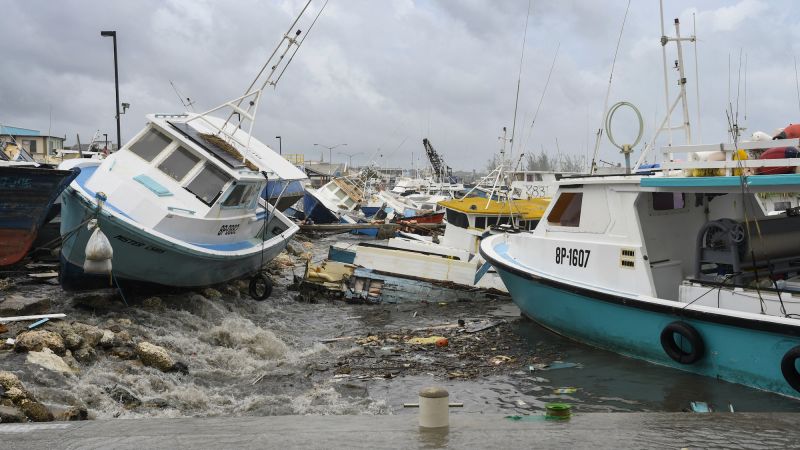
China now has the first samples ever collected from the far side of the moon and says it will share them with scientists around the world. But US access could be hampered by a 2011 law that prohibits space coordination between NASA and China without special authorization. Here’s what else you need to know to Get Up to Speed and On with Your Day. Hurricane Beryl is churning toward Jamaica as a dangerous Category 5 storm after leaving at least one person dead and inflicting ruin across the Caribbean islands on Monday. The storm has already ripped through scores of homes in Grenada and St. Vincent and the Grenadines, where many are still without power or water. Beryl continues to smash records as it kicks off an exceptionally early hurricane season — now becoming the earliest Category 5 hurricane on record and only the second Atlantic storm of such strength to be recorded in July. Forecasts show harsh winds and rain will be felt in Hispaniola today with as much as 3 feet of storm surge. Government officials have also activated national disaster response protocols in Jamaica, where water levels may rise 5 feet above normal tide levels. The Supreme Court ruled Monday that former President Donald Trump may claim immunity from criminal prosecution for some of the actions he took before leaving office. President Joe Biden condemned the decision, which ruled that presidents have absolute immunity from prosecution for core official acts, and issued a stern warning over a possible second term for Trump. “There are no kings in America. Each, each of us is equal before the law,” Biden said in a speech from the White House. Biden warned the high court set a “dangerous precedent because the power of the office will no longer be constrained by the law even including the Supreme Court of the United States.” The decision will likely delay Trump’s federal election subversion trial related to his actions on January 6 even further. The Supreme Court on Monday declined to settle major questions raised in a blockbuster dispute over laws intended to protect conservative viewpoints on social media. The decision delays a final ruling on whether it is unconstitutional for states to pass laws preventing online platforms from moderating their own websites. Republican governors in Texas and Florida previously argued that laws are needed to keep sites such as Facebook and Instagram from discriminating against conservatives. The justices’ decision means the laws will remain blocked for now while lower courts continue to sort out the constitutional questions involved. Ukraine has foiled an alleged plot to overthrow the government that “would have played into Russia’s hands,” security officials in the war-torn country said Monday. Ukrainian authorities arrested at least four suspected coup organizers who allegedly planned to trigger a riot in Kyiv on June 30 as a distraction to seize control of the Ukrainian parliament and remove the military and political leadership from power. It is unclear if those accused have any connection with Russia, which has waged a devastating full-scale invasion against its southwestern neighbor for nearly two and a half years. The suspects face up to 10 years in prison if found guilty.


Travelers have been dealing with worsening airport wait times as ICE agents deploy to more than a dozen airports. Follow for live news updates.

President Donald Trump voted in Tuesday’s state House special election by mail even as he suggested on Monday that “mail-in voting means mail-in cheating.”

CNN’s 5 Things AM brings you the news you need to know every morning.

The Supreme Court on Tuesday will consider the legality of a policy championed by President Donald Trump during his first term that prevented scores of migrants arriving at the southern border from starting the process of applying for asylum.

A young, well-liked facilities manager at the Kennedy Center has gone from being described as “in charge of HVAC and toilets” to head of the renowned arts institution.

Democrats in Florida are hoping to capitalize on the party’s recent special election overperformances and come out on top Tuesday in a special state House election for a Palm Beach district that includes President Donald Trump’s Mar-a-Lago residence.

The Supreme Court on Monday appeared ready to limit mail-in ballots, a move that would reinforce the justices’ pattern of shrinking voter protections and that has, at bottom, favored Republican interests and the Trump administration.

An Air Canada plane traveling from Montreal collided with an emergency vehicle on the runway at New York City’s LaGuardia Airport in the late hours of Sunday night, killing two pilots and injuring dozens of people.

Top Senate Republicans on Capitol Hill believe their party is unified behind a plan to reopen the Department of Homeland Security. Now, they need to sell the plan to Democrats.

Markwayne Mullin will serve as Donald Trump’s next Department of Homeland Security secretary, elevating the US senator to helm the agency at the center of the president’s controversial immigration enforcement effort and an ongoing shutdown.

President Donald Trump’s sudden turnabout and, according to him, rapidly advancing peace talks made for an abrupt shift in the administration’s approach to the Iran war.

The Supreme Court’s conservative majority appeared dubious of state laws that allow the counting of mail ballots that arrive at election offices after Election Day as justices heard oral arguments in a challenge to Mississippi’s five-day grace period for mail ballots.

The chief district judge in New Jersey appointed Robert Frazer, a career prosecutor, to serve as US attorney for the state, ending for now a dispute over the legality of the office’s leadership that threatened to derail criminal investigations.