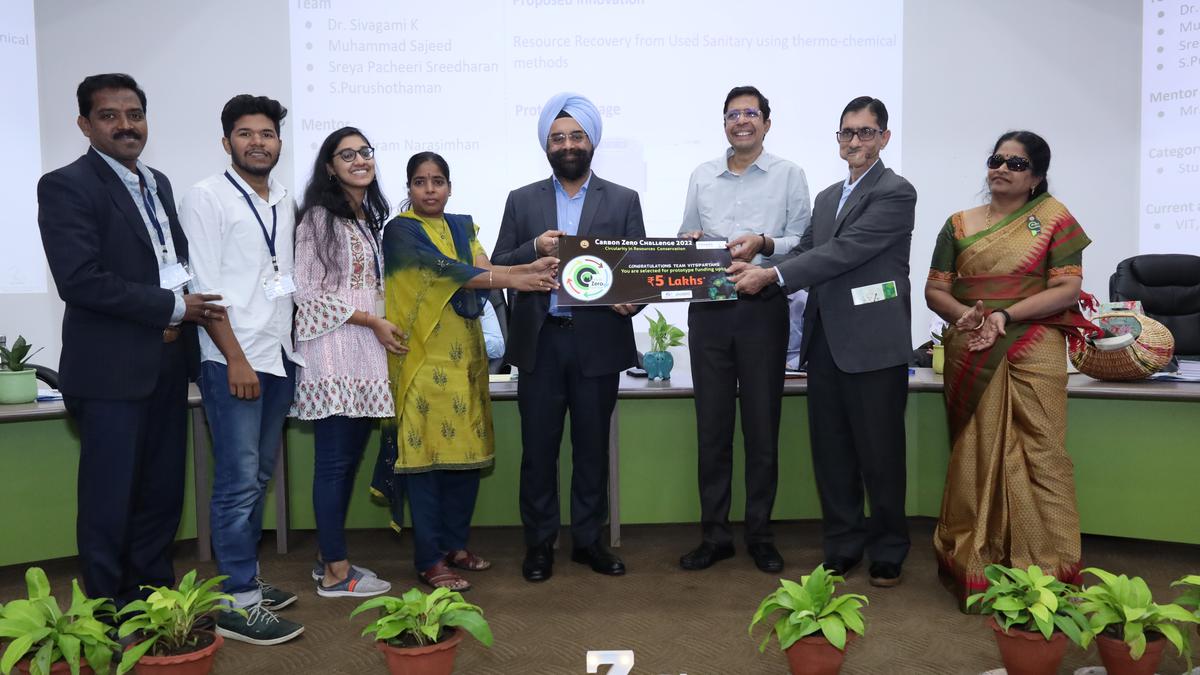
30 teams selected for Carbon Zero Challenge contest
The Hindu
Top five teams will then be selected for grant of ₹10 lakh seed capital for a start-up and support from the Institute for incubation with support from angel investors and venture capitalists
Thirty teams have been selected from among 750 who registered for the third edition of Carbon Zero Challenge competition at the Indian Institute of Technology Madras.
The selected teams will develop prototypes of an environment-friendly technology. The teams will train for six months at the institute to build a prototype of an environment-friendly technology, identify customers and develop a viable business model for commercialisation of their innovation.
Top five teams will then be selected for grant of ₹10 lakh seed capital for a start-up and support from the Institute for incubation and from angel investors and venture capitalists.
The institute has set up a centre for circularity and sustainability of entities for capacity building of industries. An end-to-end portal to receive, evaluate and track the progress of start-up ideas was launched.
Greater Chennai Corporation Commissioner Gagandeep Singh Bedi, who participated in the event, said battery operated vehicles had replaced diesel vehicles to collect waste. The city had 5,200 electric vehicles to collect waste and had started 175 micro-collecting centres to decentralise waste composting and avoid artificial mountains outside the cities, he said. “We plan to convert about 2,500 metric tonnes to bio-CNG,” he said.
Institute director V. Kamakoti announced that the institute planned to launch a dual degree programme on sustainability policy development.
Sivarajah Ramanathan, mission director and CEO of Tamil Nadu Start-up and Innovation Mission, said the State government had allocated ₹500 crore to support climate-related activities and would soon be launching an initiative to support green projects.


CM announces Cabinet Sub-Committee on Musi rejuvenation; rehabilitation for all displaced

Ramanathapuram identifies 145 polling stations as sensitive, ensuring security with paramilitary forces ahead of assembly elections, says DEO.

BJP Puducherry president V. P Ramalingam files nomination for Raj Bhavan, joined by Union Minister Mandaviya and Khushbu Sundar.

History-sheeter 'Thoppai' Ganesh shot dead by police in Chennai after attacking officers during attempted escape.

The government plans to amend the FCRA, introducing new regulations for NGO asset management and accountability for key functionaries.

The draft policy for “Responsible Digital Use Among Students”, released on Monday by the Department of Health and Family Welfare, has recommended that parents set structured routines with clear screen-time rules and prioritise privacy, safety, and open conversation with children on digital well-being.

Police Observer Sushant Kumar Saxena conducts surprise inspection at Shencottai police station, reviewing warrants and security arrangements ahead of elections.

Andhra Pradesh government to launch key projects in April, focusing on industrial growth and infrastructure development, says Nara Lokesh.

Lok Sabha refers the Corporate Laws (Amendment) Bill to a JPC amid opposition concerns over CSR provisions dilution.

SHG members in Kanniyakumari use snakes and ladders to raise election awareness and boost voter turnout.

Government accelerates consultations for early implementation of the Women’s Reservation Act to ensure women’s representation in 2029 elections.

CM A. Revanth Reddy distributes ₹1 crore insurance cheques to families of deceased Electricity department employees, enhancing financial security for workers.

The Bengaluru Traffic Police (BTP) registered 634 cases of drunk driving during a week-long special enforcement drive conducted across the city between March 16 and March 22.