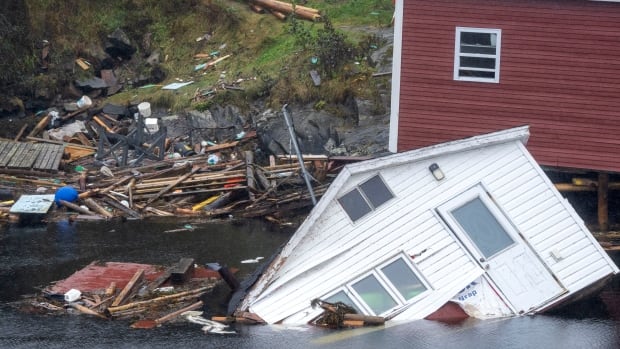
2022 was another record hot year. Experts say we must prepare for more climate-related disasters
CBC
2022 was the fifth-warmest year on record, the European-based climate service Copernicus reported on Tuesday.
It was 0.3 C above the 1991–2020 average, and 1.2 C above the pre-industrial average (1850–1900), making it the eighth consecutive year that global temperatures were more than 1 C above the pre-industrial average. NASA and the National Oceanic and Atmospheric Administration will release their joint findings on Jan. 12, which will likely be the same ranking or similar, as in previous years.
The fact that it was another year in the top 10 likely isn't a surprise for most people, but experts say it's concerning that the warming trend continues even in light of a cooling phenomenon called La Nina.
"It is unusual that with La Nina, which should bring cooler temperatures, that we are right now about to be confirmed [as one of the] warmest years," said Mélie Monnerat, project manager at the University of Waterloo's Intact Centre on Climate Adaptation.
"Even if 2022 was maybe not as warm as 2021, it's still ridiculously high."
There's an ocean pattern called the El Nino-Southern Oscillation (ENSO), where temperatures in a particular part of the central and eastern Pacific Ocean either warm or cool by a few degrees. When it's cooler, it's a La Nina year. When it's warmer, it's an El Nino year.
Both of these patterns have varying effects around the world, depending on where you are. But an El Nino year typically results in a warmer annual global temperature.
However, the past three years have been La Nina years — and also some of the warmest years on record, with effects felt across the globe and the country.
In 2021, Lytton, B.C., recorded the highest temperature ever in Canada, at 49.6 C. It was also almost wiped off the map following deadly forest fires. And in 2022, worldwide, there were no shortage of climate disasters, including flooding in Pakistan and Nigeria, drought in Somalia, and record-breaking heat waves in Europe.
It's a reminder that, as the planet warms, we will experience more and more climate-related disasters, and we need to be better prepared, experts say.
WATCH | What we might expect from the climate in 2023:
According to several climate agencies, La Nina is expected to transition to neutral by the summer. After that, it's possible we could transition to another El Nino, which means we could see one of the warmest years on record, perhaps beating out 2016 when the temperature was roughly 1.01 C above average.
"In our report, we cover that the last eight years have been the warmest eight years on record. Last year, we said that the last seven years have been the seven-warmest years on record," said Samantha Burgess, the deputy director of the Copernicus Climate Change Service. "The reality is that the climate that we're living in right now, our infrastructure is not fit for this purpose."
She also noted that, without La Nina in place, 2022 would have been even warmer.


After several delays to the mission that will take four astronauts around the moon, NASA held a press conference today announcing that Artemis II is on track to launch as early as April 1.

Snuneymuxw First Nation is calling for a temporary closure and environmental investigation of a hazardous waste services company following a January oil spill on Duke Point near Nanaimo, B.C.

In February, five people were killed in separate avalanches across B.C. and Alberta. That same month, more than a dozen people were killed in California and Utah, including a particularly deadly avalanche that claimed the lives of nine. In Europe, from Andorra to Slovakia, the season has recorded 125 deaths from avalanches so far.

Getting a proper vehicle to transport people for urgent medical care is an ongoing challenge in fly-in First Nations in northwestern Ontario.

A new supergroup of musicians from Six Nations of the Grand River and Mississaugas of the Credit First Nation have collaborated on a Robbie Robertson-inspired song they will perform at the Junos Honouring Ceremony later this month in Hamilton.

People as young as 45 should be invited to provincial and territorial programs to screen for colorectal cancer, the Canadian Cancer Society urged on Wednesday.

The Métis Nation-Saskatchewan (MN-S) has opened an office and retail space in Ottawa to create a stronger presence in the capital since removing itself from the Métis National Council in 2024.

Toronto resident Winhan Wong's lung cancer journey began in 2016, with a nagging cough that just wouldn't go away.

Last month, Assembly of First Nations National Chief Cindy Woodhouse Nepinak pointed out on social media that history was made this year because there are a record 164 female chiefs serving across the country.

Most of humanity has a great propensity to think in the short-term, but generally, long-term considerations — air pollution, deforestation and emissions, for example — just aren't our thing.

As the COVID-19 pandemic began to unfold in early April 2020, Kolter Bouchard was just weeks into fatherhood when he noticed a lump on his neck.

Advocates and health care providers say they remain concerned about First Nations kids seeking services under Jordan's Principle even after the Canadian government’s recent promise of $1.55 billion in funding.

Contrary to science fiction, black holes are not portals to other dimensions or cosmic vacuum cleaners that swallow up everything around them.