1st National Day for Truth and Reconciliation draws mixed feelings from Canada’s Indigenous
Global News
While Indigenous community members hope the federal holiday Sept. 30 will help raise awareness about the history of residential schools, they stress one day is not enough.
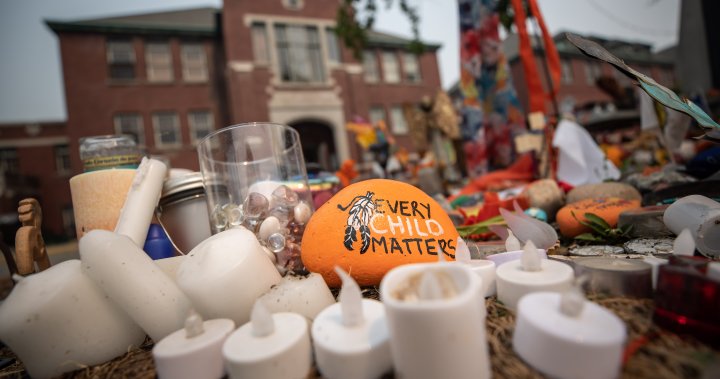
As Canada marks its first National Day for Truth and Reconciliation to honour lost children and survivors of residential schools, the Indigenous community is approaching the day with mixed emotions.
Coinciding with the annual Orange Shirt Day, Sept. 30 is being recognized as a federal statutory holiday to give Canadians a chance to reflect on the legacies of the residential school system, colonial policies and the cultural genocide of Indigenous Peoples in Canada.
As one of the 94 calls to action from the Truth and Reconciliation Commission, it’s a “good first step” to have a formal day recognizing the genocide, but more needs to be done to deliver justice to the victims, said Dr. Sarah Funnell, a First Nations family physician and public health specialist in Ottawa, Ont.
“One day is not nearly enough,” said Funnell, who is an Algonquin native. “But we have to begin somewhere.”
The Orange Shirt Day began in 2013 to mark the story of a third-generation residential school survivor, Phyllis Webstad, whose new orange shirt – given to her by her grandmother – was stripped from her on the first day she attended a B.C. residential school.
The House of Commons unanimously supported legislation in June to also make Sept. 30 a federally recognized holiday for all government employees and workers in federally regulated workplaces.
But only a handful of provincial and territorial governments are having public servants and schools observe the day.
Ashley Bach, a member of the Mishkeegogamang First Nation, said while she was excited that the federal government was willing to support the day she said she was also “very disappointed that several provinces were not behind this at all.”


An aviation expert says Canada is losing more air traffic controllers to retirement than it is hiring, despite efforts to ramp up recruitment.

Nova Scotia Power is seeking a 3.8 per cent power rate bump retroactive to Jan. 1, and a 4.1 per cent hike that would come into effect Jan. 1, 2027.

It’s the fourth time in less than a month that a large vehicle has collided with an overpass in Saskatchewan. Three of those incidents have been reported in Saskatoon.

As part of its upcoming budget, the province is planning to ban people from reselling tickets to sports matches and concerts for more than their face value.

The company, White Wilderness Heliskiing, issued a statement on Tuesday saying the avalanche happened near Mt Knauss on the ski run Iridium Shoulder.

Three of the organization's service vehicles were badly damaged in a vandalism incident that happened sometime between midnight Friday and Saturday morning.

As the winter weather approaches, Saskatchewan residents react to the incoming inclement weather. Many are done with the winter, but a handful of businesses will benefit.

Prairie Harm Reduction said its investigation into the shortfall has just begun, but added it does not believe there is evidence of fraud, theft or personal misuse of funds.

A new poll finds there is growing support for a proposal to lower an Old Age Security (OAS) threshold for some Canadians in order to help reduce the federal government's deficit.

Canadian and American government officials discussed a proposed revival of the canceled Keystone XL oil pipeline during a meeting in Houston, Tx. this week.

This will apply to all workers in federally regulated industries such as air transportation, banking, most federal Crown corporations, ports and telecommunication, among others.

International immigration to Canada is slowing but newcomers still helped six Atlantic cities grow more than the national average last year.

Rising fuel costs stemming from the Iran war are starting to impact small and medium-sized businesses in Canada, according to the latest survey findings.