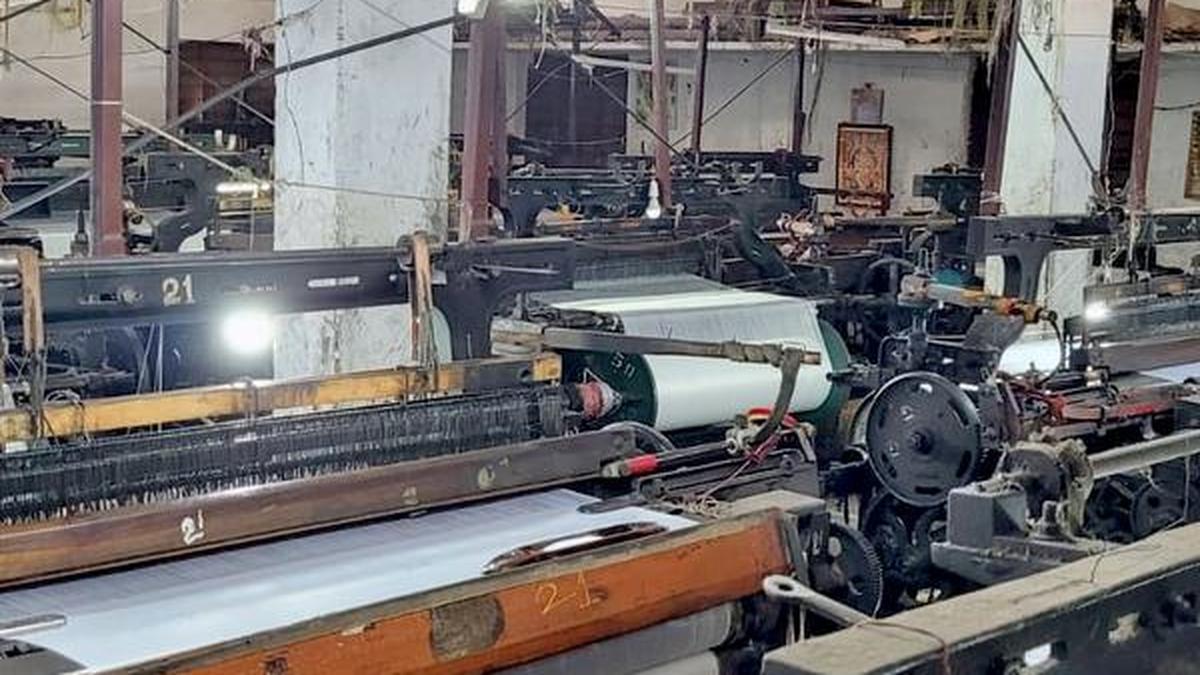
Telangans’s Sircilla power loom weavers in a knot Premium
The Hindu
Power loom workers in Sircilla, Telangana, struggle financially due to a downturn in fabric demand and rising production costs.
“My only skill is weaving, and with the abrupt shutdown of power looms over the past fortnight, I am struggling financially,” says B. Srinivas, a 35-year-old power loom worker who lives in Indiramma Colony, abutting the Sircilla Textile Park in Telangana’s Rajanna Sircilla district. “My mother took to beedi-rolling to supplement the family income, but the strenuous work fetches meagre wages and is hardly a viable source of livelihood,” he adds.
His five-member family, including mother, wife, and two children, lead a hand-to-mouth existence during the lean season, he rues. “I get anywhere between ₹12,000 and ₹15,000 as a monthly wage during the peak season and endure financial difficulties during the lean season extending to almost six months,” he says.
Nearly 1,000 power loom workers of the textile park, located 8 kilometres from Sircilla town, are staring at a bleak future as are the 9,000-odd workers employed directly and indirectly in more than 25,530 power looms in the town.
The crisis is multi-factorial. The primary catalyst is the nationwide downturn in the demand for fabric, affecting both domestic consumption and export markets. Apart from government orders, the cloth produced in Sircilla mainly goes to the Pathergatti market in Hyderabad, about 130 km away. “We used to sell polyester fabric worth around ₹300 to ₹350 crore per annum until the slowdown brought the sales to a near standstill,” says a local power loom unit owner, unwilling to be named.
The rise in production costs has compounded the industry’s woes, making it increasingly difficult for manufacturers to maintain competitiveness. This surge in costs, attributed to various factors such as increased raw material prices, labour expenses, and energy costs, has eroded profit margins. As a result, several textile units in Sircilla find themselves at a crossroads, struggling to balance sustainability and profitability. It used to cost ₹7 to make a metre of polyester fabric three years ago; now it costs around ₹8.70, the power loom owner contends.
Another indicator of the industry’s distress is the mounting stockpile of unsold polyester cloth. This surplus has left many manufacturers grappling with the challenge of managing excess inventory. Industry sources believe that polyester cloth worth over ₹100 crore is lying unsold with the power loom units in Sircilla and the textile park together.
Pending bills of bulk orders


First randomisation of EVMs and VVPATs for Tiruchi and Perambalur districts completed with political party representatives present.

Puducherry elections see ongoing DMK-Congress rift over seat-sharing, leading to candidate conflicts on nomination day.

Einstein College and Sri Sarada College in Tirunelveli celebrated significant events, honoring academic excellence and cultural heritage.

Priyanka Gandhi criticises PM Modi's West Asia remarks, urging for a comprehensive Parliament discussion on the matter.

Learn who can vote by postal ballot in the upcoming Tamil Nadu Assembly election, including seniors and persons with disabilities.

Decomposed body of a missing 25-year-old man discovered in Dindigul stone quarry, prompting calls for investigation and quarry closure.

SVEEP activities launched in The Nilgiris aim to boost voter turnout at 13 polling booths with low participation rates.

Learn who can vote by postal ballot in the upcoming Tamil Nadu Assembly election, including seniors and persons with disabilities.

Shorts News:Watch: UDF linked to communal forces in Kerala: CPI(M) leader A Vijayaraghavan

Karnataka government postpones Deendayal Upadhyaya event at KSOU Mysuru due to protocol violations and lack of government involvement.

Sameer Wankhede denies bribery allegations involving Shah Rukh Khan’s son in drugs case during Bombay High Court proceedings.

What does it take to design gloves, masks and uniform that factor in the various challenges faced by workers on the waste beat? Indore, Bengaluru and Pune have an answer

Gaurav Gogoi files nomination for Jorhat Assembly seat, marking his electoral debut in the upcoming Assam elections.